
If you ask anyone in Sicily to describe Mount Etna, you will rarely receive a simple answer. Some will speak about her with affection, almost as if they were describing a lifelong companion, while others will tell stories of eruptions, earthquakes, ash-covered roads and sleepless nights. Farmers praise the extraordinary fertility of the land, while business owners remember cancelled reservations, disrupted transport and the uncertainty that always accompanies life in the shadow of Europe’s most active volcano. The truth is that Etna cannot be described in a single sentence because she is, and always has been, a contradiction. She is magnificent and destructive, generous and unpredictable, comforting and intimidating. She gives life and takes it away, inspiring admiration throughout the world while simultaneously reminding those who live beside her that nature has never promised to behave according to human expectations.
This week has been a perfect example of that contradiction. Flights have been cancelled or diverted for days, Catania Airport has experienced major disruption and volcanic ash has travelled far beyond Sicily, reaching Malta and affecting life across a much wider area than many people expected. For most people around the world, these events become dramatic headlines accompanied by spectacular photographs of lava fountains illuminating the night sky. For those of us who live here, however, the experience is entirely different. Behind every headline are real people trying to reach their destinations, business owners wondering whether guests will arrive, families changing their plans and entire communities attempting to adapt to circumstances that can change from one hour to the next.
Perhaps the most extraordinary aspect of all this is that people continue to admire her. This may be because Etna has never pretended to be anything other than what she is. Unlike many natural landmarks that remain largely unchanged from one generation to another, Etna is alive. She breathes, shifts, expands and reshapes herself continuously. Every eruption alters the landscape, new lava flows create new terrain and ancient pathways disappear while others emerge. The mountain that visitors climb today is not the same mountain their grandparents knew, and yet she remains unmistakably Etna.
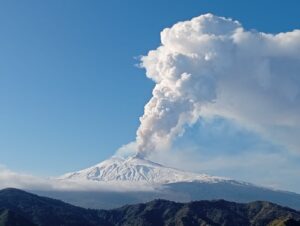
For thousands of years, people have chosen to settle on her slopes despite understanding the risks involved. Entire civilisations have lived, worked and built their communities around a volcano capable of extraordinary destruction. On the surface, this may seem irrational, but anyone who has spent time here understands why. Etna gives as much as she takes.
The fertility of the volcanic soil has supported agriculture for centuries. Vineyards, olive groves, citrus orchards, pistachio plantations and fruit farms flourish on land enriched by volcanic minerals. Traditional agricultural landscapes, ancient stone walls and historic wineries have become inseparable from the mountain itself. The richness of the soil has allowed generations of Sicilians to cultivate crops of exceptional quality while preserving a remarkable biodiversity that defines this corner of the island.
I am reminded of this every day as I look across the Alcantara Valley from Vista Alcantara. The olive trees surrounding the retreat owe much of their vitality to the volcanic earth beneath them, while the landscape that guests admire from the terraces exists because of countless eruptions that have shaped this territory over thousands of years. Even the colours that make eastern Sicily so distinctive, the striking contrast between black lava stone and brilliant green vegetation, are the result of the mountain’s continuous transformation.
Without Etna, this landscape would not exist in its present form. Without Etna, the vineyards would be different, the valley would have a different character and many of us might never have chosen to build our lives here. This is the blessing that the whole world admires.
The difficulty, of course, is that admiration comes at a price. The romantic images promoted in travel brochures rarely include photographs of ash covering terraces, cars and swimming pools. They do not show the endless sweeping required after an eruption, nor do they capture the anxiety experienced by businesses that depend on tourism. They do not explain the frustration of watching flights disappear from departure boards while visitors struggle to reach their destinations.
This week has demonstrated that reality perfectly. Airports have been disrupted, travellers have been stranded and tourism-related businesses have been forced to adapt. The disruption has affected far more than transport because every cancelled flight has a ripple effect that touches hotels, restaurants, tour operators, accommodation providers and countless other businesses that depend on visitors arriving when they are expected.
And yet, perhaps the most remarkable aspect of living beside Etna is that nobody is ever truly surprised. We may become frustrated and complain while spending hours cleaning volcanic dust from terraces and pathways, but deep down we all understand the same fundamental truth. The volcano is simply doing what volcanoes do.
There is a lesson in this that extends far beyond geology. Modern life encourages us to believe that everything can be controlled. We create schedules, business plans and long-term strategies. We organise our lives with extraordinary precision and assume that preparation will protect us from uncertainty. Then life intervenes. Illness appears unexpectedly, relationships change, financial challenges arise or natural events transform everything overnight. If you happen to live in eastern Sicily, that interruption may arrive in the form of an active volcano deciding that the airport should remain closed for another week.
Living beside Etna teaches humility because it forces us to acknowledge something that many people spend their lives trying to avoid. Control is often little more than an illusion.
This is one of the reasons I believe so strongly in the healing power of nature. At Vista Alcantara, many guests arrive physically and emotionally exhausted. They are overwhelmed by responsibilities and disconnected from themselves after years of moving from one obligation to another without ever slowing down. Their nervous systems have adapted to a relentless pace, and many have forgotten what it feels like to experience genuine stillness.
Something remarkable happens when people spend a few days in the mountains. The silence becomes noticeable, the rhythm of the day slows and the horizon expands. Guests spend time outdoors, sit quietly with their thoughts and gradually begin to reconnect with aspects of themselves that have been neglected for far too long. Nature has a remarkable ability to restore perspective because it reminds us that we are part of something much larger than ourselves.
Standing in the shadow of Etna is a profoundly humbling experience because the mountain operates according to a completely different timescale. Human concerns that seem overwhelming in the city often appear surprisingly small when viewed against a landscape that has been evolving for hundreds of thousands of years. The mountain does not hurry, the olive trees do not hurry and the seasons do not hurry. Only human beings insist on rushing through life while expecting immediate answers and instant solutions.
Perhaps this is why so many people who visit Sicily describe feeling calmer without fully understanding why. They are adapting to a different rhythm, one that has been shaped by nature rather than by deadlines. This rhythm is particularly evident at Vista Alcantara, where Etna is never simply part of the scenery. She is a constant presence that influences the landscape, the atmosphere and the way people experience this part of Sicily.
The contradiction fascinates me because it mirrors the human experience so perfectly. We all carry periods of calm and periods of upheaval within us. We all experience moments of creation, destruction, rebuilding and transformation. We all struggle to find a balance between stability and change, and perhaps this is why Etna attracts millions of visitors from around the world. They do not come simply to observe geological activity. They come because the volcano awakens something much deeper, reminding us that nature remains untamed and that there is something profoundly reassuring about that reality.
The longer I live here, the more I appreciate this lesson. Resilience does not mean resisting every challenge, adaptation does not mean surrendering and acceptance does not mean giving up. Living beside an active volcano teaches you to continue moving forward despite uncertainty because life does not stop simply because circumstances become difficult. Breakfast still has to be prepared, guests still have to be welcomed, rooms still have to be cleaned and the olive trees still need attention.
This is why I believe Etna is both a blessing and a curse. The blessing is obvious in the landscape, the fertile land, the beauty and the extraordinary sense of place that have shaped Sicilian culture for centuries. The curse is equally obvious in the ash, the disruption, the unpredictability and the constant reminder that our plans are never entirely our own.
Yet I would not exchange one for the other because removing the risk would mean removing the very essence of this landscape. Eliminating the unpredictability would mean losing one of the most important lessons that Etna teaches so powerfully. You cannot live beside this mountain without learning respect, and you cannot admire her without accepting her contradictions.
Perhaps this is why the whole world continues to admire Etna. She represents something that modern society has almost forgotten: the understanding that true power does not need to announce itself. Long after today’s cancelled flights have been forgotten, long after this week’s ash has been washed away and long after another generation has arrived to photograph lava illuminating the night sky, Etna will still be here, quietly reshaping the landscape according to her own timetable.
And we will continue to do what Sicilians have always done. We will sweep away the ash, prepare the coffee, welcome our guests and look up at the mountain with the same mixture of admiration, frustration and affection that has defined life on her slopes for centuries, because loving Etna means accepting both the blessing and the curse.