
What is the most beautiful part of Sicily? – If you ask someone that question, you are likely to get a very different answer depending on who you ask and where they are from. Someone who loves the sea might immediately say Taormina, Cefalù or one of the island’s spectacular beaches. Someone fascinated by history might choose Syracuse, Agrigento or one of the extraordinary Baroque towns of the southeast. Others might tell you that the Aeolian Islands, the Madonie Mountains or the landscapes around Mount Etna are where Sicily is at its most beautiful. There really is no objective answer, because Sicily is such a remarkably diverse island that its beauty changes dramatically from one part to another.
Personally, however, there is a part of Sicily that I think deserves far more attention than it receives, particularly from visitors who want to experience something beyond the obvious tourist destinations. That is the Alcantara Valley in northeastern Sicily, stretching between the slopes of Mount Etna and the mountains of the Nebrodi and Peloritani ranges. It is a landscape of rivers, vineyards, olive groves, fruit trees, villages, mountains, ancient lava flows and deep gorges, and it has something that makes it particularly fascinating in the height of summer: in a season when much of Sicily becomes dry and golden beneath the Mediterranean sun, parts of the Alcantara Valley can remain remarkably green.
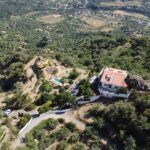
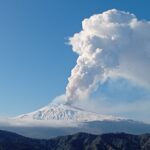
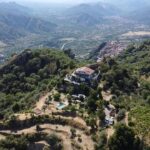
There is a very good reason for this, and it has to do with something you cannot see when you first look across the valley.
Water.
The Alcantara River itself does not actually rise underground, as is sometimes assumed. Its headwaters are in the eastern Nebrodi Mountains, at around 1,400 metres above sea level, and the river travels for approximately 50 kilometres before reaching the Ionian Sea. What makes the hydrology of the valley particularly interesting is what happens when the river enters an area strongly influenced by the volcanic geology of Mount Etna.
The volcanic rocks on the northern side of Etna are extremely permeable. Rainwater and snowmelt can infiltrate through these rocks and feed a substantial underground aquifer. The water then travels through the volcanic formations before emerging as groundwater springs further down in the Alcantara Valley, where it mixes with the river’s surface water. Scientific studies have found that this groundwater contribution helps sustain the Alcantara’s flow during the dry season.
So when you stand beside the Alcantara in summer, you are seeing only part of the story. Some of the water flowing through the valley has followed a journey that began on the slopes of Etna, disappeared beneath the volcanic landscape and eventually emerged again through the valley’s groundwater system.
There is something wonderfully extraordinary about that when you stop to think about it. The enormous volcano dominating the landscape is not simply something beautiful to look at. Its geology is actively influencing the landscape around it, including the water system that helps sustain the river and the vegetation of the valley.
The connection with snow is particularly interesting. Groundwater recharge on the northern side of Etna is influenced by precipitation, including both rainfall and snow, and that water infiltrates into the volcanic ground before contributing to the aquifer. This means that the relationship between Etna and the Alcantara is not simply a matter of what happens on the surface. There is an entire hidden system underneath the landscape connecting mountain, groundwater and river.
The result is one of the characteristics that makes the Alcantara Valley so special. The valley has a rich and varied natural environment, with vegetation changing along the different sections of the river and a mixture of river habitats, vegetation and agricultural cultivation. The official Alcantara River Park describes the valley as a diverse natural environment stretching between the Etna massif and the southern extensions of the Nebrodi and Peloritani mountains.
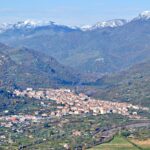
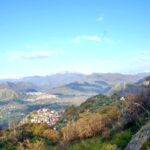
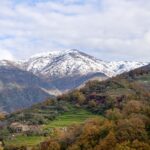
Of course, the Alcantara Valley is not green everywhere throughout every summer, and it would be misleading to suggest that the river has an unlimited supply of water regardless of weather conditions. Recent research has been looking specifically at how drought and human pressure on groundwater can affect spring discharge and the river’s dry-season flow. The system is remarkable, but it is also a natural system that can be affected by changes in rainfall, snowmelt, groundwater extraction and prolonged dry periods.
That actually makes the valley more interesting rather than less. You are not looking at some artificial green landscape that has simply been maintained for tourists. You are looking at a living landscape shaped by geology, climate, water and human cultivation over thousands of years.
There is also something else that makes the Alcantara Valley different from the image many people have of Sicily. When people imagine the island, they often picture turquoise sea, golden beaches, whitewashed towns and the dramatic terraces of Taormina. All of those things are wonderful, but they are only part of Sicily. There is another Sicily inland, where the pace is slower, the landscape is dominated by mountains rather than beaches and the countryside is still very much part of everyday life.
This is the Sicily you discover around the Alcantara Valley.
Here you can move from vineyards and olive groves to volcanic landscapes, from mountain villages to the river, from ancient agricultural land to the extraordinary basalt formations created when ancient lava flows interacted with the river. The Alcantara River Park describes the geological landscape around the basalt formations as particularly distinctive, with deep gorges and striking columnar structures carved through the volcanic rock over time.
Then there are the villages themselves. Castiglione di Sicilia, Motta Camastra, Francavilla di Sicilia and the smaller communities scattered throughout the valley offer another experience of Sicily entirely. You are no longer simply visiting a famous attraction, taking a photograph and moving on to the next one. You are moving through a landscape where agriculture, geology, water and village life are all connected.
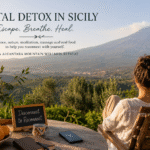
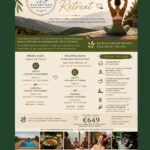

This is one of the reasons my father fell in love with this particular part of Sicily and I, eventually, created Vista Alcantara Mountain Wellness Retreat here. We are perched high above the Alcantara Valley, with views across the mountains towards Mount Etna, surrounded by olive trees, vines, fruit trees and the countryside that makes this corner of Sicily so distinctive.
From here, you can spend the morning exploring the river or one of the valley’s villages and return to the mountain in the afternoon. You can walk, swim, practise yoga, Tai Chi or Qigong, sit beneath the pergola, enjoy the view from the terraces or simply do very little at all. The beauty of being here is that you do not have to choose between experiencing Sicily and having somewhere peaceful to retreat to afterwards.
That is perhaps what I would say if somebody asked me directly, “What is the most beautiful part of Sicily?”
I would not tell them that the Alcantara Valley is objectively the most beautiful place on the island, because beauty simply does not work that way. I would tell them that if what they are looking for is a combination of dramatic mountain scenery, Mount Etna, a fascinating river, green countryside, vineyards and olive groves, traditional villages, volcanic geology and the feeling of being somewhere that has not been completely consumed by mass tourism, then the Alcantara Valley deserves a very serious place on their list.
I would also tell them not to judge it only by photographs.
There are places that look beautiful on a screen and are even more beautiful when you are standing there. Then there are places where understanding what you are looking at makes the experience deeper. The Alcantara is one of those places for me. Once you know that the river is connected to the mountains, that rain and snow can disappear into the volcanic rocks of Etna, that groundwater can emerge further down the valley and help sustain the river through the dry season, the landscape suddenly becomes more than a pretty view. You begin to see the story underneath it.
You see Etna differently. You see the river differently. You see the green valley differently. You realise that the landscape in front of you is the result of an extraordinary relationship between volcano, water, mountains and time. So, is the Alcantara Valley the most beautiful part of Sicily? I will leave that decision to you.
Sicily has too many extraordinary places to make one definitive choice, and perhaps that is exactly what makes the island so fascinating. Yet if you come looking for a different side of Sicily, one where mountains meet vineyards, where ancient lava flows meet a living river, where the landscape remains surprisingly green in the Mediterranean summer and where Mount Etna is part of the story rather than simply something beautiful on the horizon, come and discover the Alcantara Valley for yourself.
You might just find that this is the Sicily you were looking for all along.
What Is Slow Travel, and Why Is Sicily the Perfect Place to Experience It?
Where Can I Go Off the Beaten Track in Sicily to Escape Tourist Crowds and Relax in Nature?