
Mount Etna Sicily: Facts, Power and the Symbolism of Renewal
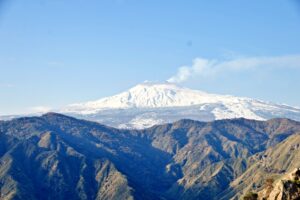
Mount Etna Sicily is one of the most powerful natural forces in Europe, shaping the landscape and identity of eastern Sicily for thousands of years.
Rising above eastern Sicily, visible from coastlines, villages and valleys alike, Mount Etna Sicily is not only the tallest active volcano in Europe — it is one of the most studied and monitored volcanoes in the world.
And yet, statistics alone do not capture its presence.
Etna is not simply a landmark.
It is a living force.
Europe’s Most Active Volcano
Mount Etna stands at approximately 3,300 metres (its height changes slightly following eruptions) and has been active for hundreds of thousands of years. Historical records of eruptions date back to 1500 BCE, making it one of the longest documented volcanic histories on Earth.
In 2013, Mount Etna in Sicily was declared a UNESCO World Heritage Site in recognition of its geological significance and ongoing scientific value.
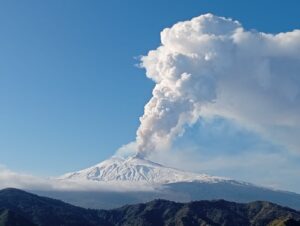
Unlike explosive volcanic systems, many of Etna’s eruptions are effusive — meaning lava flows rather than catastrophic explosions. This has allowed nearby communities to coexist with the volcano for centuries, adapting rather than fleeing.
Life here does not ignore Etna.
It respects it.
A Landscape Shaped by Fire
The eastern side of Sicily bears the imprint of Etna’s activity.
The Alcantara Gorge, for example, was formed when ancient lava flows met the Alcantara River and cooled rapidly, creating dramatic basalt columns that still draw visitors today.
The soil across the region is dark, mineral-rich and exceptionally fertile.
Vineyards flourish on volcanic slopes.
Olive trees thrive.
Apricot and almond groves produce intensely flavoured fruit.
What once flowed as molten rock now nourishes agriculture and local cuisine.
Destruction becomes fertility.
Intensity becomes growth.
Living With the Unpredictable
Etna does not follow human schedules.
Eruptions can occur with warning, but they cannot be controlled. Ash clouds occasionally dust nearby villages. Lava reshapes familiar landscapes.
And yet, communities remain.
Why?
Because living near Etna teaches perspective.
Residents understand that nature operates in cycles. There are seasons of quiet and seasons of activity. There are moments of stillness and moments of disruption.
Rather than resisting this reality, Sicilian culture has absorbed it.
Resilience here is not dramatic.
It is steady.
The Psychological Power of Volcanic Landscapes
There is something profoundly grounding about spending time near a volcano.
Visitors often describe feeling smaller — but in a relieving way. Personal worries shrink against a geological timescale stretching back millennia.
Mount Etna is estimated to be over 500,000 years old. Lava fields tell stories long before modern life existed. Standing near its slopes or observing it from a distance shifts perception.
Problems feel temporary.
Change feels natural.
Intensity feels survivable.
This psychological recalibration is one reason many people feel drawn to eastern Sicily during periods of transition in their lives.
Renewal as a Natural Law
Volcanic systems embody a powerful truth:
Nothing remains static.
Eruptions clear old vegetation. Lava reshapes terrain. Over time, life returns — often stronger than before. The very minerals released during eruptions create some of the most fertile agricultural land in Europe.
Renewal is not separate from disruption.
It follows it.
In personal growth, the pattern is similar.
Old emotional structures sometimes need to soften before new clarity emerges. What feels like breakdown can precede breakthrough. What feels like loss can precede alignment.
Mount Etna does not rush this process.
It demonstrates it.
Mount Etna Sicily and the Rhythm of Nature
From villages like Motta Camastra to coastal towns near Catania, Etna remains a constant presence.
Sunrises illuminate its slopes in soft pink tones. At night, during active periods, lava glows against dark skies. Even in quiet phases, its silhouette shapes the horizon.
Agriculture adapts to its soil. Architecture reflects its stone. Local wine carries the flavour of its minerals.
Etna is not an attraction added to the landscape.
It is the landscape.
Why Visitors Feel Something Here
Many travellers arrive expecting scenic views.
They leave describing something deeper.
Perhaps it is the contrast between fire and fertility.
Perhaps it is the reminder that instability and growth coexist.
Perhaps it is simply the humbling scale of geological time.
Whatever the reason, Mount Etna tends to leave an imprint.
It invites reflection without demanding it.
It represents power without aggression.
It embodies renewal without urgency.
Mount Etna Sicily is a Force That Shapes More Than Land
Eastern Sicily’s identity cannot be separated from Mount Etna.
Its eruptions have influenced migration, agriculture, architecture and local mythology. It has inspired poets and scientists alike. It continues to attract researchers studying volcanic activity and environmental systems.
But beyond geology, Etna offers something symbolic.
A reminder that cycles are natural.
That intensity is not permanent.
That renewal is possible.
In a world that often seeks control, Mount Etna represents coexistence with forces larger than ourselves.
And sometimes, standing near something ancient and powerful is enough to change how we see our own challenges.
Mount Etna was designated a UNESCO World Heritage Site in 2013 for its outstanding geological significance.
