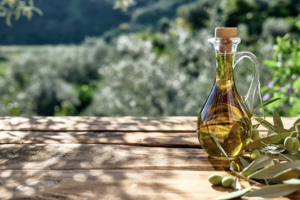
The olive harvest in Sicily. There are certain moments in the year when life in the Sicilian countryside seems to return to a rhythm that has existed for centuries. The days become shorter, the air takes on a different quality, and the olive trees, which have stood quietly through the heat of summer, begin to offer the fruits of another year’s growth. For those of us living among the mountains of the Alcantara Valley, the olive harvest is one of the most special times of the year. It is a time of hard work, shared meals, laughter, conversation and, ultimately, the extraordinary satisfaction of producing something that comes directly from the land.
This year, at Vista Alcantara Mountain Wellness Retreat, we have just completed a week of olive picking, and the result is something rather wonderful: our own fresh olive oil, made from olives hand-picked here on the mountain and taken to a local mill for processing. We call it liquid gold, and when you have spent days gathering each olive by hand, you begin to understand why it has always been considered one of the most precious gifts of Mediterranean life.
Yet the olive harvest is about much more than the oil itself. It is about connection: with the land, with the seasons, with the people who come together to help, and with a way of life that offers a welcome contrast to the speed and noise of the modern world.
A week among the olive trees
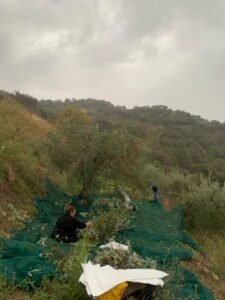
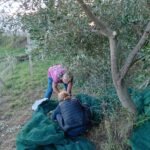
This year’s harvest brought together a lovely little international team. We had a friend from Germany, a local friend from the area, a friend from Spain and a volunteer from the United States, all coming together to help gather the olives. Different countries, different backgrounds and different lives, but for a week we shared the same simple purpose: to bring in the harvest.
There is something rather special about working together outdoors. Conversations begin, stories are exchanged, jokes are made, and people who may not have known one another before find themselves sharing an experience that is both practical and memorable. Nobody needs to organise elaborate entertainment when there are olive trees to harvest, a beautiful landscape surrounding you and the satisfaction of seeing the day’s work gathered into baskets.
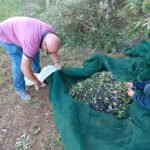
Olive picking is not particularly glamorous. It involves reaching into branches, moving around trees, collecting the fallen fruit, sorting and gathering, and repeating the process over and over again. Depending on the trees and the terrain, it can be physically demanding, and there are moments when you become very aware of muscles you had forgotten you possessed. But there is also a quiet pleasure in the repetition. You begin to notice the details: the different shades of green and purple on the olives, the silvery underside of the leaves, the changing light across the valley and the distant outline of Mount Etna.
And, of course, there is the conversation. Some of the best exchanges happen when people are doing something together rather than sitting opposite one another trying to think of something to say. Work becomes companionship, and the hours pass in a way that feels quite different from an ordinary working week.
The silence of the Sicilian mountains
One of the things I treasure most about living here is the silence. Not the artificial silence of a closed room, but the kind that belongs to the natural world. There is the occasional bird, the rustling of leaves, the sound of wind moving through the trees and, sometimes, the distant activity of life in the valley below. But there is no constant traffic, no crowded streets, no relentless background noise demanding our attention.
During the olive harvest, that silence becomes part of the experience. You can spend hours outdoors with the trees, looking across the mountains and allowing your thoughts to settle. There is time to talk when you feel like talking and time simply to work quietly alongside somebody else. Nobody needs to fill every moment with conversation, music or entertainment.
For people who spend much of their lives surrounded by notifications, deadlines, traffic and the demands of modern working life, this can be surprisingly restorative. We often imagine that rest means doing absolutely nothing, but sometimes it means doing something meaningful at a slower pace. It means being physically present, using our hands, noticing the world around us and allowing the mind to step away from its usual concerns.
At Vista Alcantara, we believe that the natural environment is an important part of the experience of staying here. The mountain setting, the open views, the surrounding countryside and the distance from the noise of busy towns offer an opportunity to experience a different rhythm of life. The olive harvest is perhaps one of the most authentic expressions of that rhythm.
This year’s harvest: a little more liquid gold
One of the most encouraging aspects of this year’s harvest has been the amount of oil obtained from the olives. Last year, we produced approximately one litre of oil for every ten kilograms of olives. This year, the yield was around two litres for the same quantity.
That is a significant difference, and it made the effort of gathering the crop particularly rewarding. The amount of oil obtained from olives can vary considerably from one season to another. It depends on several factors, including the variety of olive, the maturity of the fruit, the growing conditions and the characteristics of the particular harvest.
We also experienced less rainfall this year than last year, and it is possible that the drier conditions contributed to the higher oil yield. However, rainfall is only one part of a complex picture, and without analysing the fruit and comparing the growing conditions in detail, it would be difficult to attribute the difference to one factor alone. What we can say is that this year’s olives gave us a considerably better yield, and we are delighted with the result.
There is a particular satisfaction in knowing that the oil comes from trees growing on the land around your home. It is not an anonymous product arriving from somewhere else. It is connected to a specific place, a particular season and the people who have spent their time bringing the harvest in.
From tree to table: how our olive oil is made
Our olives are harvested by hand, using traditional methods, rather than being collected through large-scale mechanical harvesting. Hand picking is a slower process, but it allows us to work carefully among the trees and gather the fruit with attention.
Once harvested, the olives are taken to a local olive mill for processing. This is an important part of producing good-quality olive oil. Freshly harvested olives should be transported to the mill promptly, because delays can encourage deterioration and fermentation, which may negatively affect the quality of the final oil.
At the mill, the olives are cleaned and processed mechanically to separate the oil from the rest of the fruit. The oil is not chemically refined or extracted using solvents. It comes directly from the olives through mechanical processing, which is the basis of virgin olive oil production.
Our aim is to produce extra virgin olive oil through a careful, traditional process, with temperature control during extraction. Under European regulations, the term first cold pressing is reserved for qualifying virgin or extra virgin oils obtained below 27°C through a first mechanical pressing using a traditional hydraulic press system. The term cold extraction applies to qualifying oils obtained below 27°C through percolation or centrifugation. These distinctions matter, because the words used to describe olive oil have specific meanings under European rules.
What makes the experience especially meaningful to us is that the process remains connected to local knowledge and local production. The olives grow here, we pick them ourselves, and they are processed at a nearby mill. There is a satisfying continuity between the tree and the table, and a reminder that good food does not need to travel halfway around the world before it reaches us.
The result is an extra virgin olive oil that represents this year’s harvest and the work that went into it. Every bottle carries a little of the landscape in which the olives grew.
The changing rhythm of the olive harvest in Sicily
The timing of the olive harvest has always been closely connected to the agricultural calendar, local traditions and the maturity of the fruit. In my grandparents’ time, it was common in our family experience to harvest much later, sometimes in January or February. Many local families still associate the beginning of the olive harvest with the period after the Day of the Dead, on 2 November, when the agricultural work of autumn traditionally gathered pace.
Today, however, many growers begin harvesting much earlier, often from mid to late October, depending on the variety, location and maturity of the olives. This is not necessarily a universal change across Sicily, because harvesting dates differ from one area and farm to another, but the earlier start has become increasingly familiar in many places.
There are several reasons why growers may choose to harvest earlier. The maturity of the olives is important, because it influences both the quantity of oil and its characteristics. Some producers prefer to pick while the fruit is still relatively green, seeking particular qualities in the oil, even if the overall yield may be lower. Others wait longer for the fruit to mature further and potentially obtain more oil.
Changing weather patterns may also be influencing the agricultural calendar. Research into the historical olive-growing calendar in Sicily has documented changes in recent decades and describes how climate-related events can affect olive development and harvest conditions. However, the timing of any individual harvest is influenced by several factors, and it would be too simplistic to attribute every earlier harvest directly to climate change.
For us, the decision to begin in October is based on the condition of our olives and the practical considerations of bringing in the crop at the right time. The important thing is to pay attention to the trees, the fruit and the season rather than follow a date on the calendar simply because that is when previous generations harvested.
There is something quite beautiful about this relationship with the land. You learn to observe, to adapt and to understand that each year has its own character. Nature does not produce identical seasons, and perhaps that is one of the reasons we should pay more attention to it.
A different kind of holiday: joining us for the olive harvest
One of the things this year’s harvest reminded me of is how enjoyable it can be to share rural life with people from different parts of the world. Our little team brought together friends from Germany, Spain, the United States and Sicily, and the experience was richer because of that mixture.
At Vista Alcantara, we would love to welcome people who are interested in experiencing something a little different from a conventional holiday. If you enjoy nature, appreciate traditional food, are curious about rural Sicilian life and would like to spend some time outdoors, you might find the olive harvest a memorable experience.
We would be delighted to hear from anyone interested in volunteering during next year’s harvest. It is an opportunity to spend time in the countryside, learn a little about olive picking, meet people from different backgrounds and experience the seasonal rhythm of a small mountain property in Sicily.
This is an invitation to participate in a genuine agricultural activity, not a promise of a packaged holiday or a luxury farm experience. Olive picking involves physical work, time outdoors and a willingness to get involved. In return, there is the pleasure of contributing to something tangible, enjoying the mountain environment and sharing the satisfaction of seeing the olives transformed into fresh oil.
Anyone considering joining us should get in touch in advance so that we can discuss the likely dates, the nature of the work, accommodation arrangements and practical details. Harvest dates depend on the season and the condition of the olives, so we cannot promise that every year will follow precisely the same timetable.
More than a retreat: experiencing the seasons at Vista Alcantara
Vista Alcantara is a place shaped by its surroundings. Perched above the Alcantara Valley, with views towards Mount Etna and the mountains of eastern Sicily, it offers a setting in which nature is not simply something to look at from a window. It is part of everyday life.
The seasons bring their own experiences. There are the warmer months, when the terraces and swimming pool invite long, unhurried days outdoors. There are quieter periods when the mountains take on different colours, the air becomes cooler and the landscape invites walking, reflection and time away from the usual demands of daily life. And then there is the olive harvest, when the land provides a reason for people to come together and take part in a tradition that remains central to rural Mediterranean culture.
We offer a place for people who value peace, nature and genuine hospitality. Some guests come to practise yoga or meditation, others simply want to explore Sicily, visit the Alcantara Gorges, discover nearby villages or spend time in a peaceful setting. Some arrive alone, others with friends or family. What they share is an appreciation for a slower, more personal experience.
The olive harvest offers another way to understand what makes this place special. It is not something we have created for visitors; it is part of the life of the property. The trees were here before the guests arrived, and they will continue to be here long after this year’s bottles of oil have been enjoyed.
A little piece of Sicily to take home
As we finish the harvest and look at the oil produced this year, there is a sense of gratitude. Gratitude for the trees, for the people who gave their time and energy, for the friends who travelled to help, and for the opportunity to live in a place where the connection between the land and daily life remains so tangible.
The olive harvest is hard work, but it is also a reminder of the rewards that come from patience, cooperation and paying attention to the natural world. It reminds us that some of the most meaningful experiences are not necessarily the most elaborate. Sometimes they are found in a week spent outdoors, in conversations shared between rows of olive trees, in a simple meal after a long day, or in the first taste of oil made from fruit you have gathered yourself.
And perhaps that is what we would most like people to experience when they visit Vista Alcantara: not simply a place to sleep while exploring Sicily, but an opportunity to feel part of the landscape, even if only for a little while.
If you would like to experience the Sicilian countryside, discover the beauty of the Alcantara Valley or join us for next year’s olive harvest, we would love to hear from you.
Here, among the mountains, there is always room for another pair of helping hands, another story around the table and another person to share the silence with.
From our olive trees to your table, a little taste of Sicily.